Image

Fight Club (1999 David Fincher)
Wednesday, 14 June 2017

Friday, 26 May 2017
Artist Research and Identity across products
Researching artists, videos and ancillary tasks for your project.
For your G324 project you are not simply creating a music video, but in reality you are creating:
(Only you will be 'borrowing' a real song to use for the video part)
Your blog and your research should reflect this. You will also have to answer the following evaluation question.


"A promotion package for the release of an album, to include a music promo video, together with two of the following three options:So in reality you are creating a new band, and promoting a new fictitious album from them.
a website homepage for the band;
a digipak for the album’s release;
a magazine advertisement for the digipak."
(Only you will be 'borrowing' a real song to use for the video part)
Your blog and your research should reflect this. You will also have to answer the following evaluation question.
How effective is the combination of your main product and ancillary texts?
So this means you need find the links between the digipak, promo video and website.
Today you need to look at real artists to see how they do this.
Run The Jewels - RTJ 3
Digipak

Promo Video
Tuesday, 14 March 2017
G324 - Evaluation Questions
In the evaluation the following four questions must be addressed:
- In what ways does your media product use, develop or challenge forms and conventions of real
media products?
-
How effective is the combination of your main product and ancillary texts?
-
What have you learned from your audience feedback?
-
How did you use media technologies in the construction and research, planning and evaluation
stages?
Examiners Report June 2016
Some useful highlights from the full report
MUSIC VIDEOS:
"There were a few truly outstanding music videos, as always, but in general many moderators were a little disappointed with the submissions for this brief; as one moderator put it, ‘some of the music promos bring out clichéd products’.
However, some moderators noted that in the Music Videos there was an increase in performance and less dependence on narrative, with almost all candidates demonstrating the ability to lip synch and shoot a variety of set ups to cover the performance.
Some very impressive music videos were seen which demonstrated a clear understanding of the conventions of the form, with candidates exploring a range of genres and forms. A number of videos were more conceptual this session. Some videos captured their respective generic tones very well (a ska-based track seen by one moderator was particularly effective in its use of cameras attached to the instruments themselves, including a trombonecam).
Less successful music videos tended to demonstrate errors which have been outlined in previous reports: over-long takes, poor synching, editing which did not match the rhythm of the song, content which did not match generic expectation, repetitive structure or a lack of thought in terms of mise-en-scene, weak lighting etc.
In general, these issues had been reflected in the comments and marking, although some work was over-rewarded. And as one moderator summed up for many, we saw: ‘too many videos that show a happy couple, one of them finds out the other is unfaithful, then they split up…. Break up usually shown on a sofa.’ It is also advised that candidates ‘avoid videos from out of the window of a car’ – especially shooting scenes at night."
EVALUATIONS
This element frequently seems to be rushed by candidates, they are advised to timetable sufficient time for this process.
Question 1; there was a large number of candidates who only addressed their main task production, with no mention of ancillary texts; other candidates didn't reference existing media products in their response to Q1 - just outlining general genre conventions.
Question 3 - responses were often limited to evidence of audience research rather than a discussion of the findings and how that impacted on their production; candidates need to conduct more detailed feedback and then evaluate what has been learnt from this, not just describe the results.
Question 4 some very detailed responses which covered not only the technologies used but the processes candidates had gone through to use them. The best answers linked clearly to research, planning and production, with detailed reflection and consideration. The weakest responses were, once again simply lists of technologies used with little or no analysis or discussion.
Creative use of digital technology in the presentation of responses continues to be a weakness with many centres, though some have really tackled the issue of presentation of evaluations well, with candidates using a different method for each of their four responses. The best evaluations utilised more than one method in each response. It was disappointing to see a large number of evaluations presented simply as unillustrated essays either directly on to the blog, Word documents or as brief text-based PowerPoint presentation; none of these make sufficient use of ICT
‘Documentary ‘making-of’ style videos are always a delight and usually communicate candidates’ ability so much more effectively than text ever could’; in fact, a combination of director’s commentaries, Prezis, podcasts and comprehensively-illustrated and hyperlinked blog posts worked well.
Some candidates presented video responses that were 20 minutes long, which demonstrated their engagement but which were very difficult to moderate - a well-focused, well-illustrated 5-minute response should be long enough. Also, it is vital that when there are group presentations, candidates either introduce themselves or are captioned, so moderators can identify them and their respective contributions.
MUSIC VIDEOS:
"There were a few truly outstanding music videos, as always, but in general many moderators were a little disappointed with the submissions for this brief; as one moderator put it, ‘some of the music promos bring out clichéd products’.
However, some moderators noted that in the Music Videos there was an increase in performance and less dependence on narrative, with almost all candidates demonstrating the ability to lip synch and shoot a variety of set ups to cover the performance.
Some very impressive music videos were seen which demonstrated a clear understanding of the conventions of the form, with candidates exploring a range of genres and forms. A number of videos were more conceptual this session. Some videos captured their respective generic tones very well (a ska-based track seen by one moderator was particularly effective in its use of cameras attached to the instruments themselves, including a trombonecam).
Less successful music videos tended to demonstrate errors which have been outlined in previous reports: over-long takes, poor synching, editing which did not match the rhythm of the song, content which did not match generic expectation, repetitive structure or a lack of thought in terms of mise-en-scene, weak lighting etc.
In general, these issues had been reflected in the comments and marking, although some work was over-rewarded. And as one moderator summed up for many, we saw: ‘too many videos that show a happy couple, one of them finds out the other is unfaithful, then they split up…. Break up usually shown on a sofa.’ It is also advised that candidates ‘avoid videos from out of the window of a car’ – especially shooting scenes at night."
EVALUATIONS
This element frequently seems to be rushed by candidates, they are advised to timetable sufficient time for this process.
Question 1; there was a large number of candidates who only addressed their main task production, with no mention of ancillary texts; other candidates didn't reference existing media products in their response to Q1 - just outlining general genre conventions.
Question 3 - responses were often limited to evidence of audience research rather than a discussion of the findings and how that impacted on their production; candidates need to conduct more detailed feedback and then evaluate what has been learnt from this, not just describe the results.
Question 4 some very detailed responses which covered not only the technologies used but the processes candidates had gone through to use them. The best answers linked clearly to research, planning and production, with detailed reflection and consideration. The weakest responses were, once again simply lists of technologies used with little or no analysis or discussion.
Creative use of digital technology in the presentation of responses continues to be a weakness with many centres, though some have really tackled the issue of presentation of evaluations well, with candidates using a different method for each of their four responses. The best evaluations utilised more than one method in each response. It was disappointing to see a large number of evaluations presented simply as unillustrated essays either directly on to the blog, Word documents or as brief text-based PowerPoint presentation; none of these make sufficient use of ICT
‘Documentary ‘making-of’ style videos are always a delight and usually communicate candidates’ ability so much more effectively than text ever could’; in fact, a combination of director’s commentaries, Prezis, podcasts and comprehensively-illustrated and hyperlinked blog posts worked well.
Some candidates presented video responses that were 20 minutes long, which demonstrated their engagement but which were very difficult to moderate - a well-focused, well-illustrated 5-minute response should be long enough. Also, it is vital that when there are group presentations, candidates either introduce themselves or are captioned, so moderators can identify them and their respective contributions.
Tuesday, 28 February 2017
The Leveson Inquiry & The Leveson Report
Produce a post / Take notes on The Leveson Inquiry & The Leveson Report (Not the same thing)
1) When did the INQUIRY take place How long did it last?
2) When was the REPORT published?
https://www.theguardian.com/media/2012/nov/29/leveson-report-key-points
http://www.bbc.co.uk/news/uk-20543133
3) Summarise the key RECOMMENDATIONS of the Leveson Report
4) Summarise the key FINDINGS of the Leveson Report (not the same thing as recommendations)
5) Who were some of the key witnesses who testified at the inquiry? http://www.bbc.co.uk/news/uk-18899085
1) When did the INQUIRY take place How long did it last?
2) When was the REPORT published?
https://www.theguardian.com/media/2012/nov/29/leveson-report-key-points
http://www.bbc.co.uk/news/uk-20543133
3) Summarise the key RECOMMENDATIONS of the Leveson Report
4) Summarise the key FINDINGS of the Leveson Report (not the same thing as recommendations)
5) Who were some of the key witnesses who testified at the inquiry? http://www.bbc.co.uk/news/uk-18899085
Monday, 6 February 2017
G325 - Media Regulation Examples
How do these examples show how Media Regulation has changed over the past 50+ years? Do we think it has changed for the better or worse?
YOUR NOTES ARE HERE:
FILM & The BBFC
Collect at least three quotes explaining how the BBFC treated the following films
Historical: The Devils (1971 Ken Russell) http://www.bbfc.co.uk/case-studies/devils
Contemporary: Antichrist (2009 Lars Von Trier) http://www.bbfc.co.uk/case-studies/antichrist
Antichrist Commentary: http://www.dailymail.co.uk/debate/article-1200742/CHRISTOPHER-HART-What-DOES-film-banned-days.html
French Conservative group bans Antichrist seven years after release:
The PCC / IPSO & the regulation of the PRESS:
1) Historical 1992 - The false accusation of Colin Stagg for the murder of Rachel Nickell:
https://www.theguardian.com/news/blog/2008/dec/17/rachel-nickell-case-history
2) Mark Lawson on Colin Stagg
"For more than a decade, he was generally assumed in media coverage to be guilty of a gruesome murder on Wimbledon Common, despite the inconvenient failure of any charges to stick. By the time he was cleared of involvement, the media hunting of the aptly named Stagg had caused great pyschological cost to him, and the financial cost to the taxpayer of compensation."
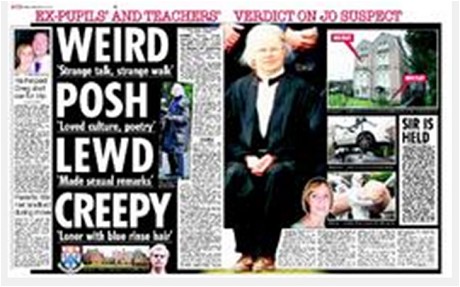
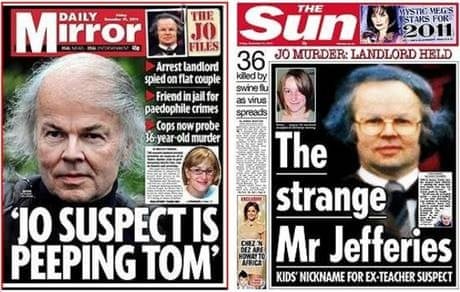
2) Contemporary 2009 - The false accusations and insinuations of Christopher Jefferies in the murder of Jo Yeates
- http://www.radiotimes.com/uploads/images/Original/64251.jpg
- http://catherinebrown.org/wordpress/wp-content/uploads/2014/12/suncoverage_2068326c.jpg
- https://i.guim.co.uk/img/static/sys-images/Guardian/Pix/pictures/2014/12/5/1417794178028/89728387-10e9-486f-b1cb-ec7bdbf5d604-bestSizeAvailable.jpeg?w=700&q=55&auto=format&usm=12&fit=max&s=0b74847512d0c586b7f2b7cb689a9363
- 101231mail.jpg
- https://blogger.googleusercontent.com/img/b/R29vZ2xl/AVvXsEiiWlknIYyPY6DZi-MAnijMx_apiMmfSKVRCmMbVHW6BVupczRuLkhYLcNGj2gKqzJrkOG20aslopBy7pvDgaSSTt_dse4FUFnTSQrEde0P33BlT2_p8vYPL4W0-4hRTOjp8JdnVPvp8LYw/s1600/101231mail.jpg
Opinion and commentary
1 Hacked Off Opinion (remember they are biased) http://hackinginquiry.org/press-abuses/ (Scroll down)
2 http://www.pressgazette.co.uk/chrs-jefferies-says-ipso-regulator-wont-deliver-access-justice-press-victims/
3 Apologies to Mr Jefferies: http://tabloid-watch.blogspot.co.uk/2011/07/page-two-apologies-to-christopher.html
2 http://www.pressgazette.co.uk/chrs-jefferies-says-ipso-regulator-wont-deliver-access-justice-press-victims/
3 Apologies to Mr Jefferies: http://tabloid-watch.blogspot.co.uk/2011/07/page-two-apologies-to-christopher.html
Friday, 6 January 2017
REVISED RESEARCH AND PLANNING
Using the videos we watched in class today (see below), make a research and planning post about how you intend to use the techniques within your own A2 project. Screengrab relevant examples to evidence your planning.
https://www.youtube.com/watch?v=UivZrL2znh0
- The Blaze - Virile (dancing in flat) https://www.youtube.com/watch?v=ryH5cga0yUI
- Kate Nash - Foundations https://www.youtube.com/watch?v=TMSSqCEZaOk
- Me and Mandy https://www.youtube.com/watch?v=uhpjB5IVH9M&feature=kp
- Will Young - Changes https://www.youtube.com/watch?v=boo2Zm69fhY
- Florence and The Machine (Best styling)
Wednesday, 21 December 2016
Best Music Videos of 2016
Updated as they come in:
- NPR Best Music Videos of 2016: http://www.npr.org/series/502554465/best-music-videos-of-2016
- Stereogum Best Music Videos of 2016: http://www.stereogum.com/1913887/the-50-best-music-videos-of-2016/franchises/2016-in-review/
- Pitchfork Best Music Videos 2016: http://pitchfork.com/features/lists-and-guides/9979-the-best-music-videos-of-2016/
Friday, 16 December 2016
IMPORTANT: Backing up your blogs
Hi Guys,
We need you to add a personal email address to your blogs as a way of backing them up, and making sure you can always have access to them.
Follow the instructions here to do this!
- Mr Lane
We need you to add a personal email address to your blogs as a way of backing them up, and making sure you can always have access to them.
Follow the instructions here to do this!
- Mr Lane
Wednesday, 14 December 2016
TIPS FOR THE EXAM TOMORROW
Click on the link below to help you for the exam tomorrow:
QUESTION 1A AND 1B HELP FROM THE EXAM BOARD
Good luck
Mrs H
QUESTION 1A AND 1B HELP FROM THE EXAM BOARD
Good luck
Mrs H
Wednesday, 23 November 2016
We The Media & Citizen Journalism
How are these videos connected?
They are all examples of 'citizen journalism' and so called 'We Media' as defined by Dan Gillmor in 2004 in his book 'We The Media'.
- https://www.theguardian.com/commentisfree/2014/aug/16/fergusons-citizen-journalists-video
- http://www.huffingtonpost.com/michael-nigro/post_11089_b_9319686.htm
- https://mediactive.com
How does this connect to press regulation?
Because, through bypassing the traditional media 'Gatekeepers' of the major press organisations and media institutions, citizen journalists are not under the auspices of press regulators such as IPSO: link to the organisations regulated by the IPSO
Does this mean the press regulator is an increasingly irrelevance?
On the other hand, is it a good thing that we have unregulated 'citizens' doing the role of professionals? (Imagine if we had 'Citizen Heart Surgeons' for example)
Tuesday, 22 November 2016
Press Regulation Essay Plan
Prepare an essay plan for the following question;
You should have examples and arguments that support and argue against increased press regulation, n, for and against statutory and self regulation.
There are *lots* of examples on google classroom, and on this blog below, to help you prepare for the question.
Assess the arguments for the regulation of the press in 2016.
You should have examples and arguments that support and argue against increased press regulation, n, for and against statutory and self regulation.
There are *lots* of examples on google classroom, and on this blog below, to help you prepare for the question.
Wednesday, 19 October 2016
Leveson and beyond
Phone hacking, the PCC, Leveson and beyond.
Nick Davies, Phone Hacking, and Rupert Murdoch.
---
---
- Leveson Report: At a glance: http://www.bbc.co.uk/news/uk-20543133
- Leveson Inquiry: The Key Findings https://www.theguardian.com/media/2012/nov/29/leveson-report-key-points
- Press Regulation Q&A: http://www.bbc.co.uk/news/uk-21797513
- What was the Leveson Inquiry?
- Why did it take place?
- When did it take place?
- What did it recommend?
--
5 - Summarise a story about press regulation today. What are the issues today around regulating the press?
---
Sunday, 9 October 2016



Wednesday, 5 October 2016
G325 - BBFC Mini Essay
You need to complete a mini essay on this question:
"Discuss the arguments for the regulation of film in 2016"
---
Your essay should focus primarily on the BBFC, but you may address other organisations (such as the MPAA, OFCOM, GRA, and PEGI) if you wish.
Your essay should include at least three specific examples of films.
Your essay should include at least three specific examples of media theory and/or theorists.
Your essay should reference the regulation of film
- in the past ( > 5 years ago)
- today
- in the future
"Discuss the arguments for the regulation of film in 2016"
---
Your essay should focus primarily on the BBFC, but you may address other organisations (such as the MPAA, OFCOM, GRA, and PEGI) if you wish.
Your essay should include at least three specific examples of films.
Your essay should include at least three specific examples of media theory and/or theorists.
Your essay should reference the regulation of film
- in the past ( > 5 years ago)
- today
- in the future
Monday, 3 October 2016
David Gauntlett's Arguments against the effects tradition.
 David Gauntlett - University of Westminster
To assert that, say, 'media violence' will bring negative consequences is not only to presume that depictions of violence in the media will always be promoting antisocial behaviour, and that such a category exists and makes sense, as noted above, but also assumes that the medium holds a singular message which will be carried unproblematically to the audience. The effects model therefore performs the double deception of presuming (a) that the media presents a singular and clear-cut 'message', and (b) that the proponents of the effects model are in a position to identify what that message is.http://www.theory.org.uk/david/effects.htm
Summarise David Gauntlett's 10 criticisms of the effects tradition. One or two sentences for each point, max!
The Hypodermic Needle Theory
Read this resource explaining the hypodermic needle theory:
Make notes and find at least five interesting points about the theory.
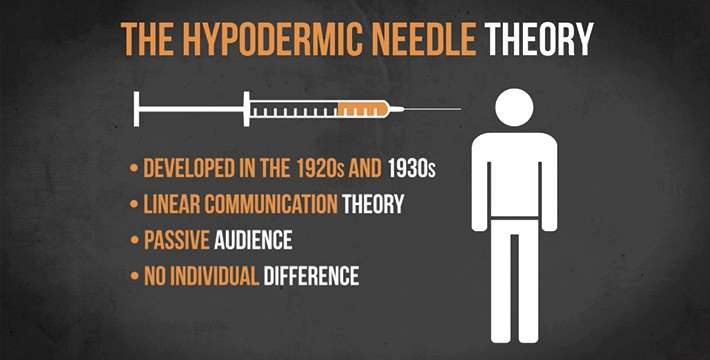
This audience effects model of media was a popular way of thinking about the media's effects on audiences in the 1930s and 1940s, until the late 1950s when Lazarsfeld and Katz developed their Two Step Flow theory of audience effects. (As opposed to the single step suggested by the hypodermic needle theory.)
TASK:
What examples can you find that indicate the BBFC used the hypodermic needle theory as a basis for their regulation of the film industry. Explain how the theory could explain or impact on the BBFC's decisions.
http://www.bbfc.co.uk/education-resources/student-guide/bbfc-history/1950s
RESEARCH TASK:
The hypodermic needle theory and it's suggestion that audiences are affected by media products directly maybe seen now as too simplistic, but we can see it's origins in Gerbner's cultivation theory. And in McCombs and Shaw's agenda setting theory. These theories are part of the effects tradition, because they suggest media has direct effects on its audiences. Find out more about these two theories, and how you think they impact on media regulation
a) today
b) in the past
c) in the future
Friday, 30 September 2016
Professor Martin Barker Media Mag Questions
In class we watched the MediaMag videos of professor Martin Barker here; https://www.englishandmedia.co.uk/media-magazine/mmag-clips/professor-martin-barker
You will need to login to watch these clips: Use the school's Media Mag login;
Username: opmedia
Password: ops2016
We then answered the questions on this google doc;
Could you ensure you have answers to the questions and extension questions, along with a definition of cultivation theory on your exam blog by next week.
- Mr Lane

You will need to login to watch these clips: Use the school's Media Mag login;
Username: opmedia
Password: ops2016
We then answered the questions on this google doc;
Could you ensure you have answers to the questions and extension questions, along with a definition of cultivation theory on your exam blog by next week.
- Mr Lane
Subscribe to:
Posts (Atom)