Image

Fight Club (1999 David Fincher)
Monday, 3 October 2016

David Gauntlett's Arguments against the effects tradition.
 David Gauntlett - University of Westminster
To assert that, say, 'media violence' will bring negative consequences is not only to presume that depictions of violence in the media will always be promoting antisocial behaviour, and that such a category exists and makes sense, as noted above, but also assumes that the medium holds a singular message which will be carried unproblematically to the audience. The effects model therefore performs the double deception of presuming (a) that the media presents a singular and clear-cut 'message', and (b) that the proponents of the effects model are in a position to identify what that message is.http://www.theory.org.uk/david/effects.htm
Summarise David Gauntlett's 10 criticisms of the effects tradition. One or two sentences for each point, max!
The Hypodermic Needle Theory
Read this resource explaining the hypodermic needle theory:
Make notes and find at least five interesting points about the theory.
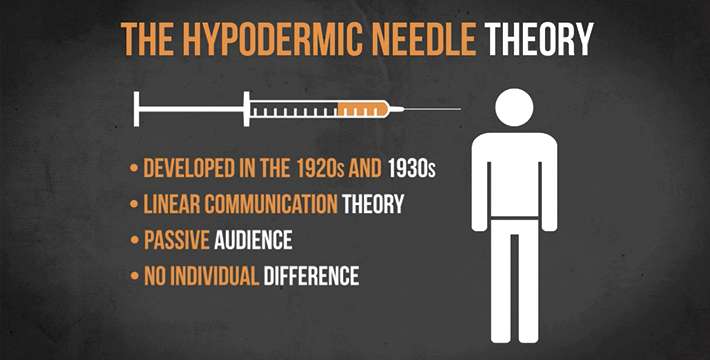
This audience effects model of media was a popular way of thinking about the media's effects on audiences in the 1930s and 1940s, until the late 1950s when Lazarsfeld and Katz developed their Two Step Flow theory of audience effects. (As opposed to the single step suggested by the hypodermic needle theory.)
TASK:
What examples can you find that indicate the BBFC used the hypodermic needle theory as a basis for their regulation of the film industry. Explain how the theory could explain or impact on the BBFC's decisions.
http://www.bbfc.co.uk/education-resources/student-guide/bbfc-history/1950s
RESEARCH TASK:
The hypodermic needle theory and it's suggestion that audiences are affected by media products directly maybe seen now as too simplistic, but we can see it's origins in Gerbner's cultivation theory. And in McCombs and Shaw's agenda setting theory. These theories are part of the effects tradition, because they suggest media has direct effects on its audiences. Find out more about these two theories, and how you think they impact on media regulation
a) today
b) in the past
c) in the future
Friday, 30 September 2016
Professor Martin Barker Media Mag Questions
In class we watched the MediaMag videos of professor Martin Barker here; https://www.englishandmedia.co.uk/media-magazine/mmag-clips/professor-martin-barker
You will need to login to watch these clips: Use the school's Media Mag login;
Username: opmedia
Password: ops2016
We then answered the questions on this google doc;
Could you ensure you have answers to the questions and extension questions, along with a definition of cultivation theory on your exam blog by next week.
- Mr Lane
Friday, 23 September 2016
Tick sheet for Coursework Research and Planning A2
- Analyse AT LEAST 5 videos in your chosen music genre and embed the YouTube videos onto your blog to gain maximum marks.
- Upload images and analysis of location, costume, props etc
- Make sure you have a photo storyboard/drawn storyboard/animatic plus analysis INCLUDING changes made and why
- Include an audience questionnaire about audience expectations of videos in your chosen genre - embed the Survey Monkey link
- Lyrics analysis with initial ideas (include shot types and possible edits you intend to use).
- Research of music video directors - eg. David Fincher - with conventions they use in their work
- Research into websites and digipacks - put the analysis of the Kanye West Rolling Stone cover in with this - Link to artist research examples here
- Images and analysis of 2 music magazine adverts for a forthcoming tour of an artist like yours
- Theory posts - Andrew Goodwin, Tori Kelly, Facial expressions, Laura Mulvey
- Your final pitch: Make sure you have a narrative analysis of your planned pitch
- Embed rough cuts of your work with feedback from public and changes made
Tuesday, 20 September 2016
The BBFC
THIS IS NOW HOMEWORK TOO
I need you to summarise and create a post on all our work on the BBFC.
USE THIS WEBSITE FIRST: http://www.bbfc.co.uk/education-resources
1) A brief history of the BBFC - how it was founded, how it's role has changed.
2) What case studies (key films or events) have caused these changes at the BBFC?
3) What the key pieces of legislation are that govern how the BBFC works as a regulator.
4) How the BBFC is different today than it was at other times in it's history.
5) How does the BBFC classify and rate films today? (What are the certificates and what is allowed in each)
6) What challenges the BBFC has going forwards, how it's role has changed?
----
Further reading:
http://www.bbfc.co.uk/case-studies <- BBFC's most controversial or interesting decisions.
- What does the Video Recording Act say?
Here is a link to some of the BBFC's most interesting or controversial decisions:
http://www.bbfc.co.uk/case-studies
I need you to summarise and create a post on all our work on the BBFC.
USE THIS WEBSITE FIRST: http://www.bbfc.co.uk/education-resources
1) A brief history of the BBFC - how it was founded, how it's role has changed.
2) What case studies (key films or events) have caused these changes at the BBFC?
3) What the key pieces of legislation are that govern how the BBFC works as a regulator.
4) How the BBFC is different today than it was at other times in it's history.
5) How does the BBFC classify and rate films today? (What are the certificates and what is allowed in each)
6) What challenges the BBFC has going forwards, how it's role has changed?
----
- What allows the BBFC to licence films for the public?
- What legislation does the BBFC use when classifying films?
- What does the Obscene Publications Act say?
- What does the Video Recording Act say?
- Why was the Video Recording Act changed via the criminal justice and public order act?
? When was it changed and how was it changed?
-----
THE VIDEO NASTIES
What were the Video Nasties? Why were they an issue for The BBFC?
http://www.screenonline.org.uk/film/id/591919/
http://www.independent.co.uk/arts-entertainment/films/features/film-censorship-how-moral-panic-led-to-a-mass-ban-of-video-nasties-9600998.html
https://en.wikipedia.org/wiki/Video_nasty
http://www.bbfc.co.uk/education-resources/education-news/video-nasties
http://www.denofgeek.com/movies/15968/the-era-of-the-video-nasty
http://www.screenonline.org.uk/film/id/445733/index.html
Here is a link to some of the BBFC's most interesting or controversial decisions:
http://www.bbfc.co.uk/case-studies
Subscribe to:
Posts (Atom)